Two Ais Walk Into A Bar -- A Better Explanation and Comparison of ChatGPT and Claude
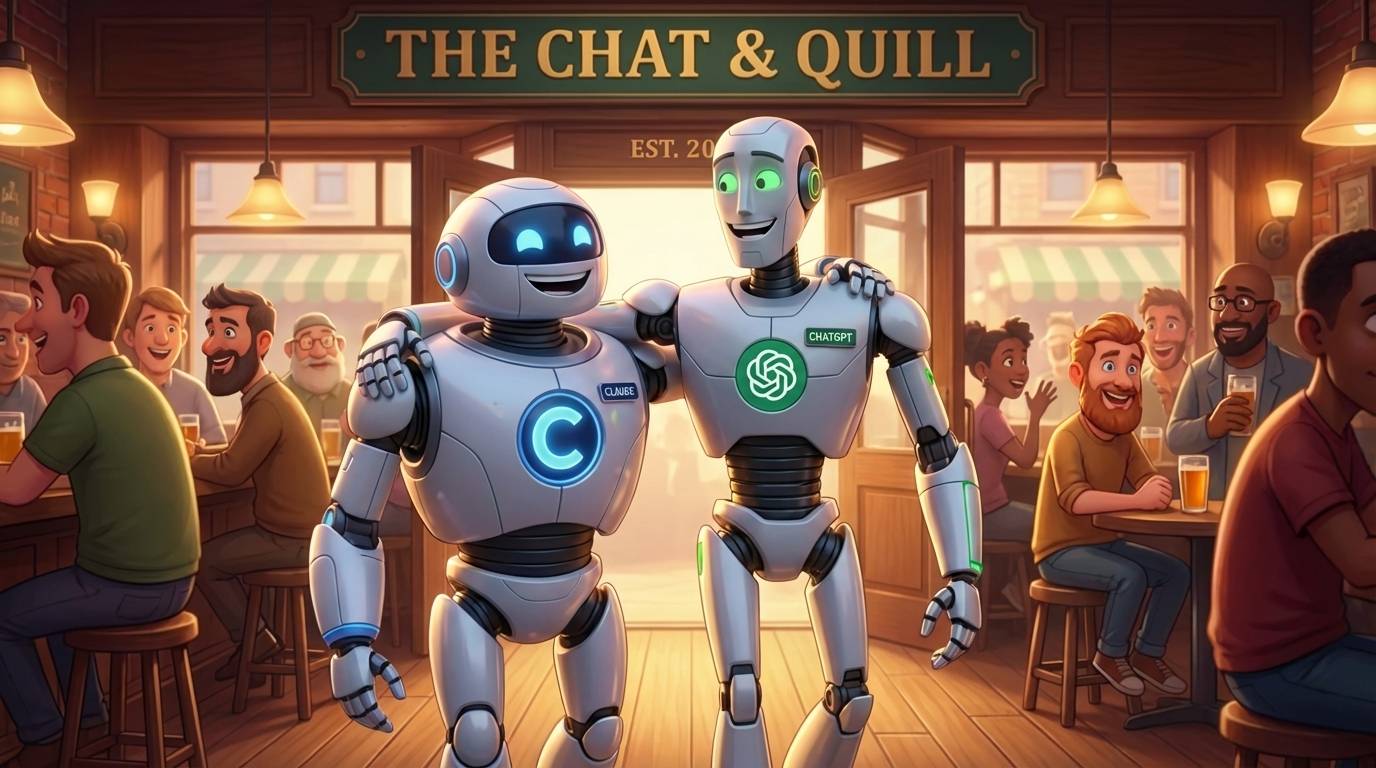
Two AIs Walk Into a Bar
By Annie Rhodes | AI Alchemy with Annie
Here's the thing about reviewing AI tools -- the more you use them, the more you realize a single review barely scratches the surface. I covered ChatGPT and Claude head-to-head in my last Lab Report, and everything I said stands. But I had some very interesting conversations with soime of my friends and colleagues who use them in ways that I don't have an opportunity to, and I started noticing things. Things that don't fit neatly into a comparison scorecard. Things that are actually more important than which one "wins."
So Episode 003 of my podcast isn't a do-over. It's what happens when you keep running the experiment after the first report is filed.
Astro is back. He has opinions. Let's go.
These Are Not the Same Tool. Stop Treating Them Like They Are.
This is the thing that keeps nagging at me -- and honestly, the AI hype machine is mostly responsible for it. ChatGPT and Claude get positioned as direct competitors, two fighters in the same weight class, and the whole conversation becomes "which one is better?" That framing is doing both tools a serious disservice.
They were not built to do the same thing. They were built with different priorities, different strengths, and frankly, different personalities. Comparing them directly is a little like comparing a chef's knife to a Swiss Army knife and declaring a winner. The answer depends entirely on what you're making for dinner.
ChatGPT comes from a place that prioritized breadth and ecosystem -- integrations, custom GPTs, image generation, code interpreter, a massive user community that has spent years bending it to their will. It does a LOT of things, and the infrastructure around it is genuinely impressive.
Claude comes from a place that prioritized something different: nuance, reasoning, and coherence over long conversations. It's the tool you reach for when you need something to actually hold the thread -- when the task is complex, when the document is long, when the writing has to sound like a human wrote it.
Different knives. Different cutting boards. Both sharp.
The Lab Report -- Episode 003 Edition
The criteria shifted for this one. This isn't a first-look anymore -- it's a deeper look at how these two actually behave in a real workflow, over time, under pressure.


TEST 01 -- Hype Test: 4/5 for both
They both largely deliver. But here's my gripe: neither one is being hyped for what it's actually good at. The marketing puts them in a boxing ring against each other when the reality is they belong in different rooms of the same building. You're not choosing a winner -- you're choosing the right tool for the specific job in front of you. The hype hasn't caught up to that yet, and it's setting people up to be disappointed by the wrong tool for the wrong reason.
TEST 02 -- Mess Factor: 3/5 for both
This is where I want to spend some real time, because this is what nobody tells you about.
Both tools are exceptional. Both will also, given enough iterations, start to lose the plot. And I mean that literally.
Here's a real example. A friend of mine is a project manager and was building a project flow across multiple locations -- using both tools side by side to see how each handled it. ChatGPT did a genuinely wonderful job laying everything out in spreadsheet format, including map links for each location. Clean, organized, easy to follow. But it could not reliably calculate travel time between sites. That's a real gap for a location-based project.
Claude handled the project order better and did a much stronger job with drive times. But after several iterations, it started to drift. Missing details it had been tracking perfectly. Straying from the original structure until she finally had to tell it to start completely over.
And here's the thing -- ChatGPT does this too. At one point, she literally asked it once if it was getting tired, because it started dropping information it had nailed five iterations earlier. Both of them do this. It's not a bug in the "something is broken" sense -- it's just the nature of how these tools work over long sessions. They drift. They get sloppy. They occasionally forget what they were doing.
What this means for you: plugging in your information and expecting a usable result is not the workflow. Staying in the driver's seat, checking the output, course-correcting when it starts to wander -- that IS the workflow. Once you accept that, everything gets a lot less frustrating.
TEST 03 -- Oh WOW Moment: 5/5 for both
Full marks. No argument.
When they get it right, they get it RIGHT. And sometimes they get it right on the first pass, and that feeling is genuinely one of my favorite things about working with these tools. Both of them can process and synthesize information faster than I can think through it, and that never gets old.
I will be completely honest: I use one or the other every single day. I cannot imagine my workflow without them at this point. The whole point of what we're doing here at the Lab is helping you figure out which one to reach for and when -- because that's the actual skill.
TEST 04 -- Astro's Approval: 5/5 for both
Astro knocks both of them off the table, enthusiastically and without preference. Equal opportunity chaos.
I will note, however, that Astro does tend to use Claude when he needs to think through something philosophical. He hasn't explained his reasoning and I haven't pushed it.
VERDICT: APPROVED -- Both of them.
In this case, the ChatGPT vs. Claude conversation was never a competition. Use both. Learn what each one is good at. Build a workflow that uses the right tool for the right job. That's it. That's the whole lesson.
Listen to Episode 003
I go deeper on all of this in the podcast, including specific things I noticed when I deliberately tested ChatGPT on tasks I normally hand to Claude and vice versa. A few results genuinely surprised me.
Two AIs Walk Into a Bar -- Episode 003 on YouTube
Want the Full Workflow Breakdown?
The podcast is the conversation. The Lab Notes are where I show you the actual step-by-step -- no fluff, no complexity theater, no "and that's basically it!" without actually showing you the thing.
Get on the list for Annie's Lab Notes Vol. 1 -- drop me a message and I'll make sure you hear about it first. Astro has approved the cover. That's all I'm saying.

AI Alchemy with Annie: Lab Director
By day, Annie tests software for a living. By night--and honestly, most of the day too--she's running AI tools through their paces in what she calls 'the Lab,' which is really just her desk with too many browser tabs open and an orange tabby named Astro occasionally walking across the keyboard.
Annie is sharp, funny, and genuinely allergic to hype. If an AI tool doesn't actually do what it says it does, she will tell you. If it blows her mind? She'll tell you that too--and then actually teach you how to use it, step by step, no upsell required.
Astro serves as Chief Quality Assurance Officer. His rating criteria are proprietary, but 'sits next to it' is considered high praise.
Her verdict: Complexity theater is not a feature. It's a red flag.